For many packaging companies, ERP systems have been the backbone of the business for years. They handle finance, purchasing, inventory, and order processing, giving teams one central source of data.
But packaging work has changed. Product complexity has grown. Run lengths have shortened. Customer expectations have risen, and sustainability targets are now a board-level priority. Many companies have also grown through acquisitions, added plants, or launched new product lines faster than their systems could keep pace.
So the real question isn't whether the ERP still works. It's whether it still fits the needs of a modern packaging operation. If any of the following sound familiar, it's worth taking a closer look.
Summary
Modern packaging businesses often outgrow ERP systems made for simpler work. Common warning signs include spreadsheet use, separate scheduling, limited production visibility, a mixed tech stack, and trouble tracking green goals or profit.
Reviewing ERP strategy can help teams connect data and make faster, better choices.
1. Critical Processes Still Depend on Excel
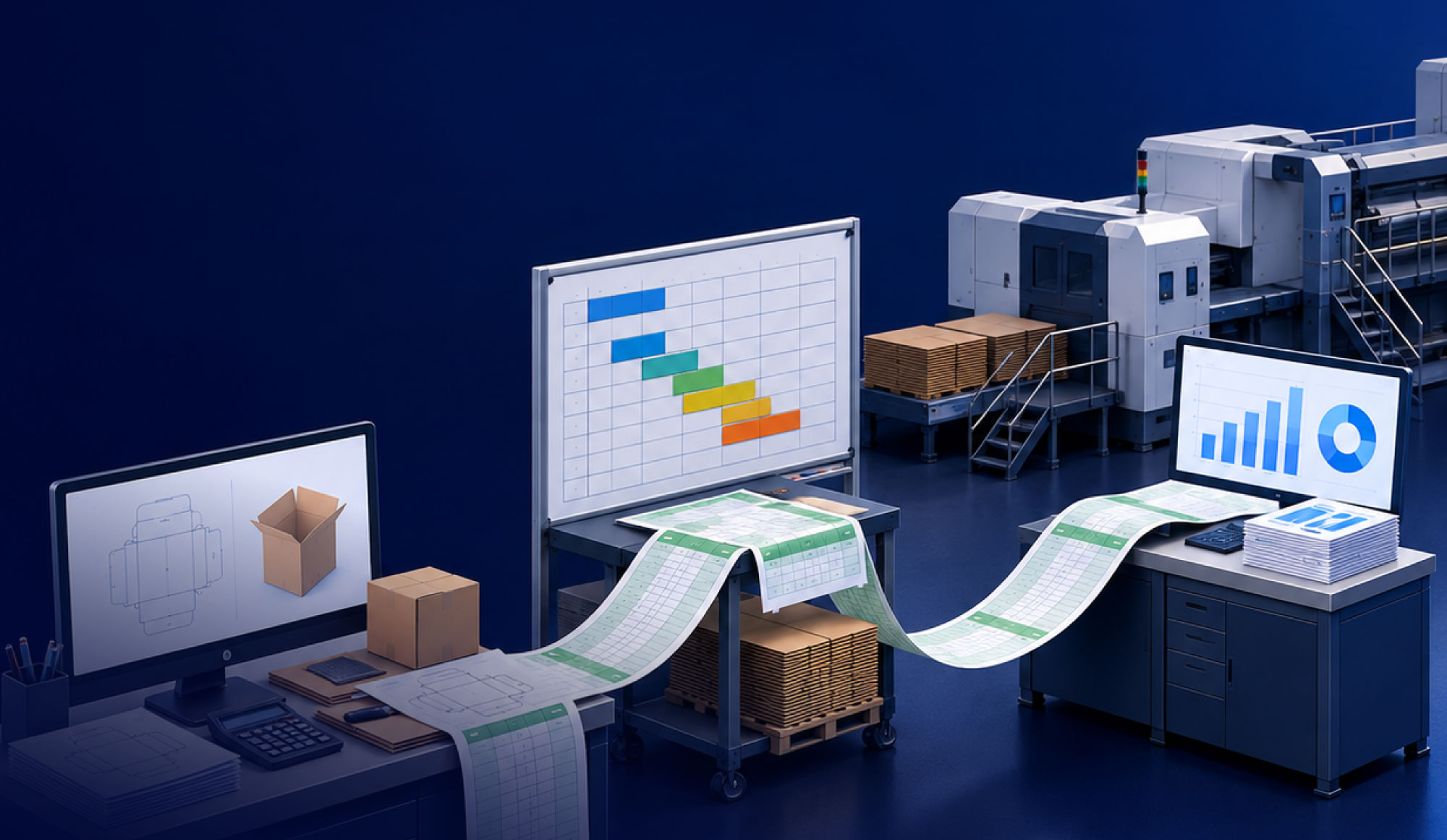
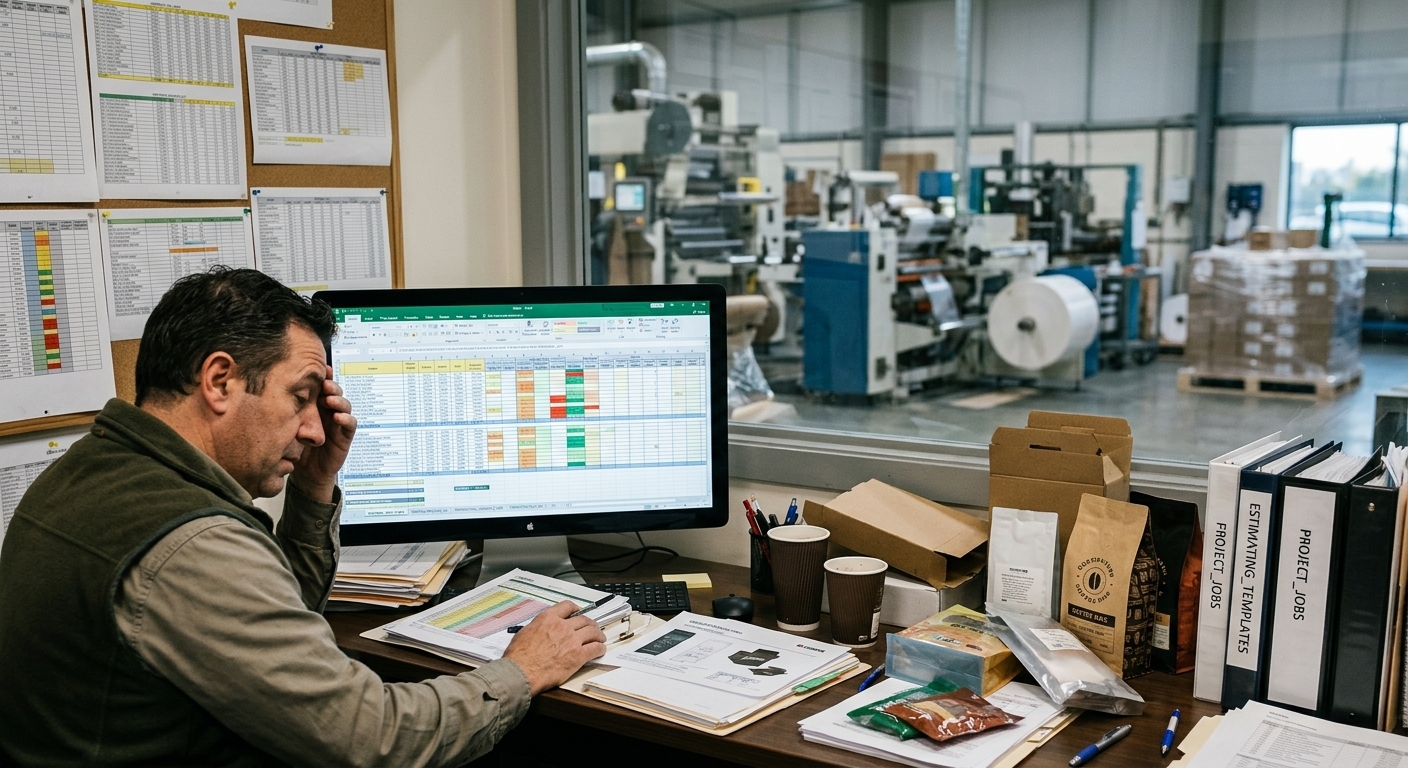
Every packaging company uses spreadsheets. That's not the problem. The problem shows up when Excel stops being a workaround and becomes the actual system, the place where estimating, scheduling, and reporting really happen, quietly, underneath whatever the ERP is supposed to be doing.
It tends to creep in around the same pressure points: complex job costing, frequent product changes, material mix calculations, waste tracking, customer-specific specs, high SKU counts. None of these are edge cases anymore. They're what a modern run looks like.
The spreadsheets rarely start as a problem. Someone hits a gap the ERP can't cover, builds a workaround, and it works, until three more workarounds stack on top of it, each one owned by a different person, none of them talking to each other. A year later, nobody remembers which file is authoritative.
Three questions tend to expose how deep this goes. Are estimators building job costs in Excel because the ERP can't hold the complexity? Are planners keeping a shadow schedule the system doesn't know about? Are month-end reports assembled by hand from two or three sources that don't reconcile automatically?
If more than one of those is yes, the spreadsheet isn't a workaround anymore. It's the system, and the ERP is just where the invoices happen to live.
2. Production Scheduling Happens Outside Your ERP
Scheduling in packaging was never going to be simple. Planners are balancing machine capacity, substrate availability, changeovers, finishing requirements, customer due dates, and labor, often across several production stages at once, and doing it in real time as orders shift.
Most ERP systems can generate a work order. Far fewer were built to optimize packaging-specific production around all of those constraints simultaneously. So scheduling migrates elsewhere: a standalone app, a spreadsheet, a planner's own mental model. The result is a gap between what's planned and what's actually running the floor, and when a schedule changes, the update travels late, gets duplicated, or doesn't travel at all.
You can usually spot this by watching where the friction lives. Printing and finishing schedules get managed as two separate exercises instead of one. Capacity planning needs someone to cross-check machine availability manually. A production change takes a phone call and two follow-up emails to actually reach everyone who needs it. Planners end up spending more of their week maintaining the schedule than improving how work flows through the plant.
For growing packaging companies, this is often one of the first cracks that shows, because scheduling is where operational complexity and system limitations collide first.
3. Visibility into Production Is Limited
Most plant leaders are trying to answer a short list of questions on any given day. Which orders are at risk of missing their date? Where's the bottleneck right now? How much waste did we generate today? Which machines are underperforming? What's the actual profit on a job while it's still running, not after it closes?
In many packaging operations, getting real answers to those questions takes several reports, a couple of phone calls, and someone manually reconciling numbers that don't quite agree. By the time the answer arrives, the window to act on it has often closed. Multiply that across more than one plant and the lag compounds.
The cost isn't abstract. It shows up as slower response times, less agility when a customer changes a spec last minute, higher production risk, and, over time, less trust in the operational data itself, because everyone's learned the numbers are usually a little stale by the time they see them. Visibility used to be a nice-to-have in this industry. It's now closer to table stakes.
4. Your Technology Stack Is Harder to Manage
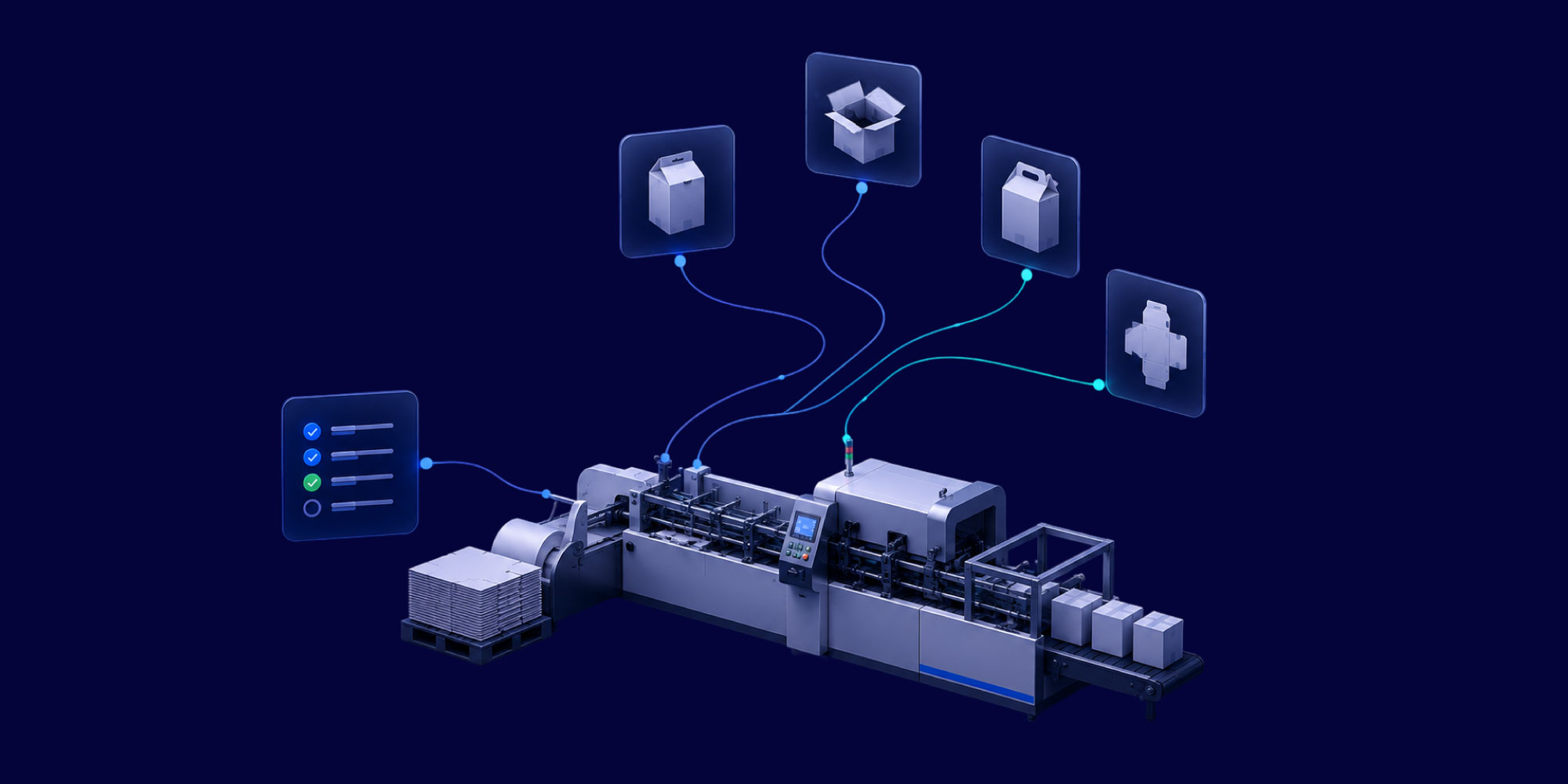
Few packaging companies set out to build a fragmented tech stack. It happens gradually. An ERP goes in first. Then you add a scheduling tool to cover what the ERP can't do. Then an MES, then a quality system, then a reporting platform, then a fresh round of spreadsheets to stitch it all back together.
The stack often ends up looking something like this:
- ERP
- Scheduling tool
- MES
- Quality system
- Reporting platform
- Excel, to tie it all together
The issue was never a shortage of software. It's that the data that should tell one coherent story is now split across systems that don't talk to each other cleanly. That split shows up as:
- Duplicate data entry across platforms
- Brittle integrations that break with every update
- Reports that contradict each other depending on which system pulled the numbers
- A rising IT bill just to keep the connections working
Many teams spend real time and budget maintaining plumbing between tools that were never designed to operate as one system, and as operations grow more complex, that plumbing gets harder to justify.
5. Green Goals and Profit Are Hard to Measure
Packaging manufacturers are under pressure from two directions at once: perform better operationally, and prove it's getting greener while doing so. Customers are asking for more transparency. Regulations keep shifting. Executives want a clearer line between operational decisions and what actually drives margin.
The metrics that matter most are often the hardest to pin down reliably:
- Waste generation
- Material use
- Yield performance
- Carbon reporting
- Production efficiency
- Job-level profit
When getting a straight answer on any of these requires manual data collection and a spreadsheet built specifically for the occasion, visibility drops right when it's needed most, and decisions slow down with it.
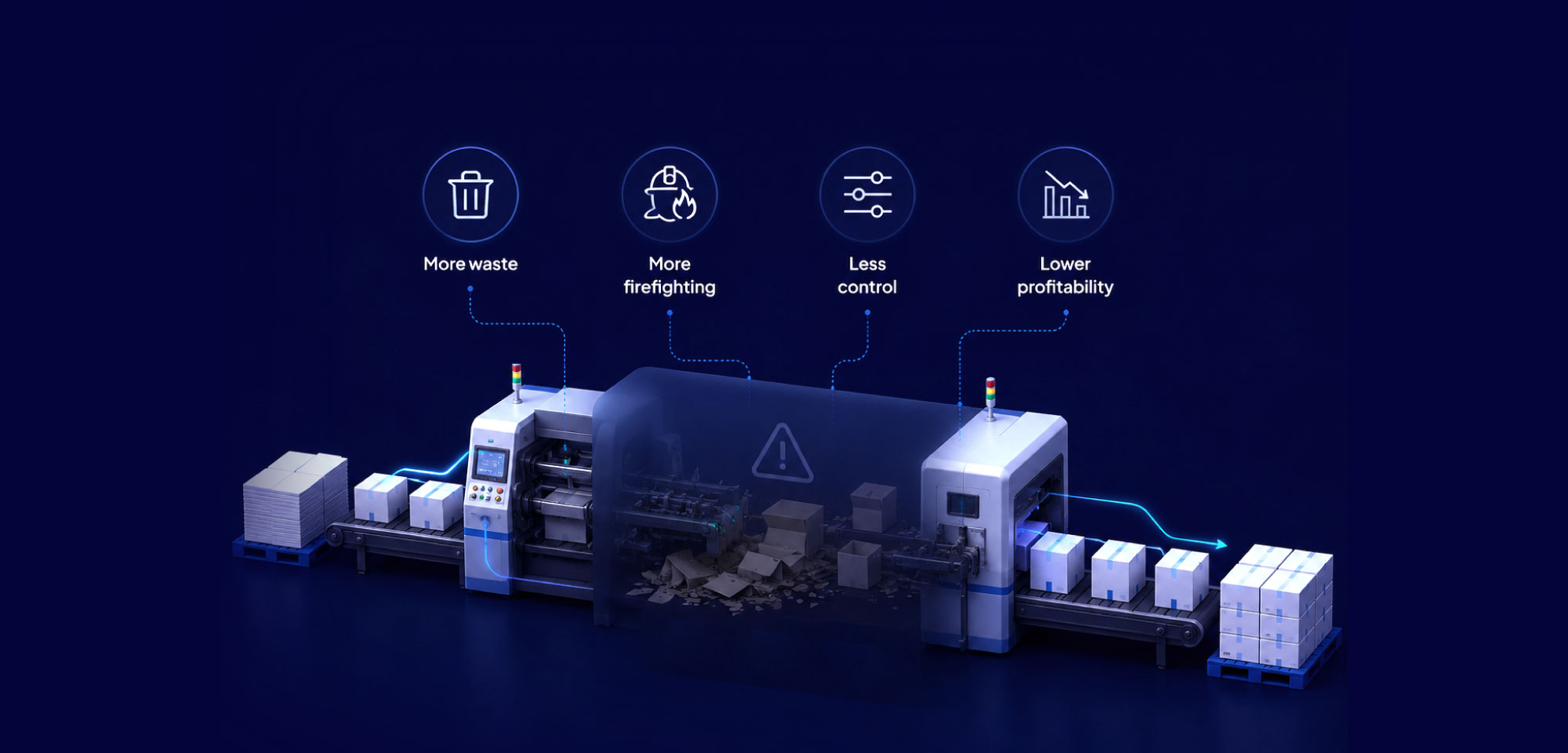
This isn't only a compliance question. It's about actually being able to see where waste is occurring and how it's affecting cost. The companies that can track waste, material use, and production performance with real precision tend to be the ones lifting margin while still hitting their sustainability commitments, not despite the tracking, but because of it.
Why More Packaging Manufacturers Are Evaluating Their ERP Strategy
In most cases, the issue isn't that the ERP has failed outright. It's that the business has moved faster than the system underneath it. Acquisitions, new plants, expanding SKU counts, shorter run lengths, sustainability requirements, and rising customer expectations have all added pressure that the original system was never asked to handle.
The result, for a lot of companies, is more spreadsheets, more standalone apps, more custom integrations, and more manual steps just to hold onto the visibility they used to have by default.
The most successful packaging companies aren't necessarily ripping out every system they own. They're taking a hard look at how estimating, planning, production, quality, inventory, and sustainability data can actually work together, and using that as the basis for better, faster decisions.
How Mature Are Your Packaging Operations?
Many packaging manufacturers still rely on spreadsheets, manual processes, and disconnected systems to manage estimating, scheduling, production, and reporting. But how does your operation compare to industry peers?